
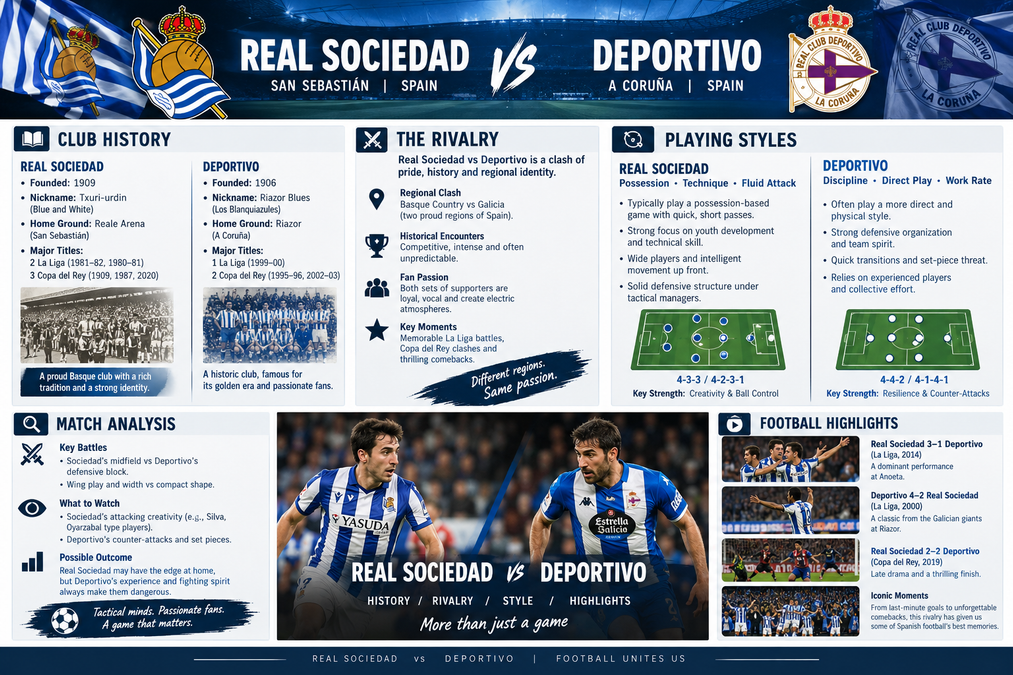

Real Sociedad vs Deportivo is an interesting fixture for football fans who enjoy Spanish football, historic club rivalries, tactical battles, and memorable league encounters. Real Sociedad, based in San Sebastián in the Basque Country, has developed a reputation for technical football, intelligent movement, and strong youth development. Deportivo de La Coruña, commonly known as Deportivo, represents Galicia and carries a proud footballing tradition shaped by memorable domestic campaigns, passionate supporters, and its determination to compete among Spain’s leading clubs.
The matchup between these teams brings together two clubs with different identities but a shared connection to Spanish football history. Real Sociedad has enjoyed successful periods in the top division and has continued to compete in domestic and European competitions. Deportivo has experienced remarkable highs, difficult setbacks, and the challenge of rebuilding its position in Spanish football. Whenever these teams meet, their contrasting journeys add another layer of interest to the contest.
The phrase Real Sociedad vs Deportivo also attracts attention from supporters looking for match results, head-to-head statistics, tactical analysis, team news, historical encounters, and future fixtures. Understanding this matchup requires more than looking at the final score. It involves examining each club’s footballing philosophy, its home advantage, its approach to attacking and defending, and the circumstances surrounding individual meetings.
Understanding Real Sociedad vs Deportivo
Real Sociedad vs Deportivo is a fixture between two well-known Spanish football clubs whose histories include periods of success, disappointment, and renewal. Real Sociedad is closely associated with the city of San Sebastián, while Deportivo comes from A Coruña in northwestern Spain. Their geographical backgrounds, local traditions, and supporters give both clubs a distinctive identity within Spanish football.
Although the teams have not always competed in the same division, their previous encounters have produced memorable results. Real Sociedad has recorded convincing victories, while Deportivo has demonstrated that it can be a difficult opponent when its players execute their tactical plans effectively. These historical meetings help explain why the fixture remains relevant to supporters interested in Spanish football.
The matchup is particularly interesting because the clubs have followed different paths through the professional game. Real Sociedad has maintained a strong connection with developing local talent and establishing a recognisable playing style. Deportivo, meanwhile, has experienced the pressures of relegation, financial challenges, managerial changes, and the difficult process of returning to a higher competitive level.
For football followers, Real Sociedad vs Deportivo is therefore more than a comparison between two team names. It is an opportunity to examine how club identity, tactical organisation, player development, and long-term planning influence results on the pitch.
Real Sociedad: Club Identity and Footballing Tradition
Real Sociedad is one of the established names in Spanish football. The club has a deep connection with the Basque region and has built a loyal following through its history, playing style, and commitment to developing talented footballers. Its home ground, Reale Arena, provides a familiar setting for supporters who expect the team to play with confidence and technical quality.
The club has enjoyed significant achievements throughout its history, including Spanish league titles and domestic cup success. Its accomplishments have helped establish Real Sociedad as a respected competitor rather than simply a team that occasionally challenges the leading clubs. The organisation has repeatedly shown that thoughtful recruitment, effective coaching, and a strong academy can create a competitive squad.
One of the most distinctive elements of Real Sociedad is its commitment to youth development. The club’s academy system has helped produce players capable of progressing into senior football and contributing at the highest level. This approach supports continuity because young players often understand the club’s expectations and playing principles before reaching the first team.
Real Sociedad’s footballing identity is also associated with technical ability and coordinated movement. The team can build attacks through the midfield, use wide areas to stretch opponents, and create opportunities through combinations between attacking players. However, its precise approach changes according to the manager, available personnel, and the strengths of the opposition.
Technical Quality and Possession Football
Possession can be an important part of Real Sociedad’s attacking strategy. By keeping the ball and moving opponents from side to side, the team can create openings that are difficult to identify when the defensive structure remains compact. Good passing alone is not enough, however. Players must recognise when to accelerate an attack, when to retain possession, and when to attempt a more direct pass.
Against Deportivo, controlling the midfield can help Real Sociedad establish the rhythm of the match. Midfielders who offer passing options between the defensive and attacking lines can make it easier to progress the ball into dangerous areas. Quick combinations can also force opposing defenders to leave their positions, creating space for runners from wide areas.
Possession becomes especially valuable when it leads to meaningful attacking opportunities. A team may dominate the ball without producing enough shots on target if its passing remains too predictable. Real Sociedad therefore benefits when patient build-up is combined with movement, intelligent positioning, and decisive finishing.
The Importance of Academy Development
Youth development is an important part of Real Sociedad’s long-term strategy. Producing players internally can strengthen the connection between the first team and the local community while helping the club maintain continuity across different seasons. Academy graduates may also provide tactical flexibility because they have grown familiar with the club’s methods.
Developing young players requires more than technical training. They must learn how to make decisions under pressure, understand defensive responsibilities, and adapt to the physical demands of senior football. The transition can take time, which makes careful coaching and sensible squad management particularly important.
In a fixture such as Real Sociedad vs Deportivo, academy development may influence the quality of the available squad and the manager’s options from the bench. Young players can bring energy and creativity, while experienced teammates provide composure and help manage difficult moments.
Deportivo de La Coruña: History, Identity, and Ambition
Deportivo de La Coruña is a historic Spanish club based in A Coruña, Galicia. Its supporters have witnessed celebrated periods in the top division, including the club’s memorable rise to prominence during the modern era of Spanish football. Deportivo’s achievements helped establish its reputation as a team capable of challenging stronger and wealthier opponents.
The club’s most celebrated period included its Spanish league title and strong performances in domestic and European competition. Those achievements remain important to its identity because they demonstrate what Deportivo can accomplish when recruitment, coaching, squad unity, and financial planning work together.
Deportivo has also experienced difficult periods. Relegation and subsequent campaigns outside the top division have forced the club to reconsider its priorities and rebuild its competitive foundations. Such setbacks can affect recruitment, finances, supporter expectations, and the development of young footballers.
Despite these challenges, Deportivo retains a passionate supporter base and a recognisable place in Spanish football culture. Its stadium, Estadio Abanca-Riazor, is central to the club’s identity and can provide an intense atmosphere when the team is playing well.
Deportivo’s Competitive Character
Deportivo’s history demonstrates the importance of resilience in professional football. A club can move from the highest level to a period of rebuilding, but recovering its former position requires patience and consistent decision-making. Successful rebuilding depends on the quality of the squad, the effectiveness of the coaching staff, and the ability to remain competitive over an entire campaign.
Against a technically accomplished opponent such as Real Sociedad, Deportivo needs to balance ambition with discipline. Pressing too aggressively without coordinated support can leave spaces behind the midfield. Defending too deeply, on the other hand, may allow the opposition to control possession and apply sustained pressure.
A well-organised Deportivo side can make matches uncomfortable by closing central passing lanes, competing for second balls, and looking for opportunities to attack quickly. These methods do not necessarily require the team to dominate possession. They require good communication, appropriate positioning, and a clear understanding of when to defend and when to move forward.
The Role of Supporters and Club Culture
Deportivo’s supporters have played an important role throughout the club’s history. Football clubs depend on more than their players and managers; they are also shaped by communities that follow them through successful seasons and difficult campaigns. Supporters help preserve the club’s identity when results are disappointing.
The atmosphere at Riazor can encourage Deportivo to play with greater intensity, particularly during important fixtures. Players often respond positively when the crowd remains engaged, although the pressure of expectations can also become demanding when results do not meet supporters’ hopes.
In away matches, Deportivo must learn to manage different environments. Visiting a stadium where the home side enjoys strong support requires concentration and emotional control. Avoiding unnecessary fouls, maintaining defensive organisation, and responding calmly after conceding can help the team remain competitive.
The Historical Rivalry Between Real Sociedad and Deportivo
Real Sociedad vs Deportivo has produced numerous meetings across Spanish football history. The clubs have shared the same division during several periods, creating opportunities for memorable victories, close contests, and changes in momentum between the sides.
Historical records show that the overall balance varies according to the competitions and matches included in a particular database. One historical record compiled by BDFutbol lists many previous meetings between the clubs, including league encounters from earlier decades. Such records provide useful context, but totals should always be interpreted with care because different databases may cover different competitions or periods. See the historical head-to-head record.
The rivalry is not necessarily defined by geographical proximity or the intense local animosity associated with a derby. Instead, it reflects the wider history of Spanish football and the different ambitions of two clubs that have competed at various levels of the professional game.
Some meetings have been particularly one-sided, while others have been closely contested. Those contrasting results demonstrate why previous scores should not be treated as guarantees of future outcomes. Team selection, managerial decisions, injuries, tactical adjustments, and match circumstances can all influence the next encounter.
Memorable Previous Encounters
Earlier league meetings between Real Sociedad and Deportivo have included high-scoring matches. In September of the 2017–2018 campaign, Real Sociedad won away against Deportivo, and the Basque side later recorded another convincing victory when the teams met again in San Sebastián.
These results became notable examples of Real Sociedad’s ability to create attacking opportunities against Deportivo during that period. They also illustrate the importance of defensive organisation. When a team concedes early goals, it may be forced to abandon its original plan and commit more players forward, creating further opportunities for the opposition.
However, historic results should be understood within their original context. The players, managers, formations, and competitive circumstances from those campaigns are not identical to those of later seasons. A useful historical analysis identifies patterns without assuming that the same events must happen again.
For supporters, these older encounters provide a way to compare different generations of players and assess how the clubs have changed. They also help explain why the fixture continues to attract interest when the teams are scheduled to meet again.
The Recent Real Sociedad vs Deportivo Match
The meeting between Real Sociedad and Deportivo on October eleventh, two thousand and twenty-six, brought the clubs together in a competitive league fixture at Reale Arena. Real Sociedad won the match by three goals to two, according to published match records. The result added a new chapter to a fixture that had not featured a league meeting between the clubs for several years.
The match was notable because Deportivo had returned to competing against Real Sociedad in the top division after a lengthy absence. Their previous league meeting had taken place in February of two thousand and eighteen, when Real Sociedad recorded a convincing victory. The more recent encounter offered a fresh comparison between two teams that had experienced different circumstances since their earlier meetings.
The five-goal scoreline suggested an entertaining contest, with both sides finding ways to threaten the opposition. A result of this kind can reveal the importance of attacking execution, defensive concentration, and the ability to respond to changes in momentum.
For Real Sociedad, winning at home provided a positive outcome in a fixture with historical significance. For Deportivo, the narrow defeat showed that the contest remained competitive despite the eventual difference on the scoreboard. The final result alone, however, does not tell the full story of every tactical decision or individual performance.
What the Result Means for Real Sociedad
A home victory can provide confidence and help reinforce the manager’s approach. Real Sociedad’s ability to score three goals against Deportivo demonstrated that the team could produce enough attacking output to secure the result, although the two goals conceded also highlight the importance of maintaining defensive concentration.
Matches with multiple goals can be particularly demanding for defenders because the flow of play may change quickly. A team that has established an advantage must continue to defend intelligently rather than assuming the contest is under control. Communication between the centre-backs, full-backs, and midfielders becomes especially important during these periods.
The result also gives supporters an opportunity to evaluate the team’s balance between attack and defence. Scoring regularly is valuable, but a club seeking consistent success must also minimise preventable goals and manage difficult phases effectively.
The wider importance of the victory depends on the surrounding league campaign. One match can influence confidence and momentum, but longer-term performance is determined by results across many fixtures. Real Sociedad must continue to produce consistent performances if it wants to meet its competitive objectives.
What the Result Means for Deportivo
For Deportivo, losing by a narrow margin can be disappointing without necessarily representing a complete failure. The team managed to score twice, showing that it could create attacking opportunities against a strong opponent. Nevertheless, conceding three goals underlines the importance of improving defensive consistency.
A useful review would examine how the goals were conceded, whether the midfield protected the defensive line effectively, and how the team responded when Real Sociedad increased its attacking pressure. Those details matter more than simply judging the performance from the final score.
Deportivo can also learn from the way Real Sociedad managed possession and attacking transitions. Analysing the opponent’s movement can help coaches identify weaknesses that need to be addressed in future matches. Training sessions can then focus on defensive spacing, recovery runs, communication, and decision-making under pressure.
The long-term value of a defeat depends partly on the team’s response. If the coaching staff identifies clear problems and the players improve in subsequent matches, a disappointing result can become a useful learning experience.
Tactical Analysis of Real Sociedad vs Deportivo
Tactics are central to understanding Real Sociedad vs Deportivo. A match between these teams can be shaped by possession, pressing, defensive spacing, the use of wide areas, and the quality of decisions made near the penalty area.
Real Sociedad may look to establish control through short passing combinations and coordinated movement. Deportivo may respond by protecting the centre of the pitch, limiting space between the defensive and midfield lines, and seeking opportunities to attack when the ball changes possession.
Neither approach is automatically superior. Possession-based football can control the rhythm of a game, but it can become ineffective if the opposition defends compactly and closes passing lanes. A counterattacking approach can create dangerous opportunities, but it requires accurate passing and the ability to exploit spaces before the defence recovers.
The tactical battle therefore depends on execution. Players must recognise changing situations, maintain their positions when necessary, and adapt when the opponent changes its approach.
Midfield Control and Passing Options
The midfield often determines whether a team can move the ball into dangerous areas. Players operating in central positions need to offer passing options, receive the ball under pressure, and make decisions quickly enough to avoid losing possession in vulnerable areas.
For Real Sociedad, midfield control can create a platform for attacking combinations. A midfielder who receives the ball facing forward can connect the defensive line with the forwards and help the team progress into the final third. Movement from nearby teammates can create passing triangles that make it harder for Deportivo to press effectively.
Deportivo can disrupt this process by narrowing the available space and forcing Real Sociedad to circulate the ball away from central areas. Good defensive positioning can make the opposition’s possession less threatening, even when the ball remains under its control for long periods.
The ability to win loose balls also matters. When a pass is intercepted or a challenge produces a rebound, the team that reacts first can gain a valuable advantage. Midfielders who anticipate these situations help their side maintain pressure or launch a counterattack.
Defensive Organisation and Compactness
Defensive organisation involves more than the actions of the defenders. The entire team must understand how to reduce space, protect the penalty area, and prevent opponents from receiving the ball in dangerous positions.
Real Sociedad must maintain a balance between pressing high and protecting the space behind its defensive line. If the forwards and midfielders press without coordinated support, Deportivo may be able to bypass the first line and attack exposed areas. If Real Sociedad retreats too far, however, it may give Deportivo time to build attacks.
Deportivo faces a similar challenge. A compact defensive block can frustrate opponents, but the team must remain alert when the ball moves into wide areas. Full-backs need support from midfielders, while centre-backs must communicate clearly to manage crosses and runners arriving near the goal.
Concentration becomes increasingly important late in a match. Fatigue can reduce reaction speed and lead to positional mistakes, making substitutes and tactical adjustments valuable tools for maintaining defensive discipline.
Attacking Transitions and Counterattacks
An attacking transition begins when a team wins possession and immediately looks for an opportunity to move forward. These moments can be particularly dangerous because the opposition may have several players positioned ahead of the ball.
Deportivo can use quick forward passes to exploit space if Real Sociedad commits players into attacking positions. Effective counterattacks require a balance between speed and control. Players must move quickly, but the first pass still needs to reach a teammate in a useful position.
Real Sociedad must also be prepared to counterpress after losing the ball. By immediately putting pressure on the player who has won possession, the team can sometimes recover the ball before the opposition launches an attack. This approach requires coordinated movement and sufficient defensive cover.
The success of either strategy depends on timing. A counterattack can lose its threat if the ball carrier waits too long, while an aggressive counterpress can create danger for the defending side if the first challenge is bypassed.
Attacking Strengths and Goal-Scoring Opportunities

Real Sociedad’s attacking potential comes from its ability to combine technical passing with movement in the final third. Players who can receive the ball between defensive lines, create space for teammates, and deliver accurate passes can help the team break down compact opposition.
Wide attacking areas can be particularly useful. When wingers move towards the touchline, they can stretch the opposing defence and create room for midfielders to advance centrally. When those same players move inside, full-backs may have opportunities to overlap and deliver crosses.
Deportivo must recognise these patterns and decide when to close down the ball and when to protect the space behind the defender. Poor coordination can leave gaps that attackers can exploit through quick combinations.
Finishing remains the decisive element of attacking play. A team may build a promising move but still fail to score if its final pass is inaccurate or its shot lacks precision. The ability to remain composed in front of goal can determine whether territorial dominance becomes a meaningful advantage.
Creating Chances Through Wide Play
Wide play offers several routes towards goal. A winger can attempt to beat a defender directly, deliver a cross, or pass the ball back towards a teammate arriving near the edge of the penalty area. These options force the defence to make decisions and can create uncertainty when multiple attackers move into dangerous positions.
Real Sociedad can benefit from changing the direction of attacks rather than repeatedly trying to penetrate the same side. Moving the ball across the pitch may force Deportivo’s defensive block to shift and can expose spaces between defenders.
Deportivo can defend wide attacks by ensuring that the full-back is not isolated. A nearby midfielder can provide support, while the centre-backs remain ready to deal with crosses. The defensive line must also monitor attackers who make late runs into the penalty area.
Good wide defending is therefore a collective responsibility. The player closest to the ball applies pressure, teammates protect passing options, and the defensive line adjusts to the movement of opposing attackers.
Finishing and Decision-Making in the Final Third
Finishing is influenced by technical ability, composure, positioning, and the amount of time available to make a decision. Attackers must decide whether to shoot immediately, take an additional touch, or pass to a teammate in a better position.
Real Sociedad benefits when its attacking players remain unpredictable. If an opponent knows that every attack will end with a shot from the same area, defending becomes easier. Varying the type of chance can create uncertainty and improve the quality of opportunities.
Deportivo can reduce the number of clear chances by blocking shooting lanes and forcing attackers into less favourable positions. Goalkeepers also play a major role through positioning, communication, and the ability to react to shots from different angles.
The quality of chances matters more than the raw number of attempts. A team that produces several shots from difficult positions may be less dangerous than one that creates fewer opportunities from close range.
Defensive Challenges and Areas for Improvement
Defensive performance often determines whether a team can turn a promising display into a positive result. Real Sociedad’s victory over Deportivo demonstrated attacking effectiveness, but the goals conceded also provide a reason to examine defensive organisation and the management of dangerous situations.
For Real Sociedad, one important consideration is the space left behind advancing players. When full-backs move forward and midfielders join the attack, the remaining defenders must be positioned to handle counterattacks. A lack of cover can allow the opponent to progress quickly into dangerous areas.
Deportivo must focus on communication and positional discipline. Defenders need to understand when to step forward, when to remain in the line, and how to coordinate their movement with midfield teammates. Small errors can create large openings when the opposition moves the ball quickly.
Both teams can also benefit from reviewing set-piece defending. Corners and free kicks create situations in which the defending team must manage several opposing runners in a limited space. Clear assignments and early communication help reduce confusion.
Managing Pressure During Difficult Periods
Football matches rarely proceed according to a single plan from beginning to end. A team may enjoy a strong opening period before the opposition adjusts its tactics. The ability to respond to those changes often separates organised sides from teams that struggle to maintain control.
Real Sociedad must be prepared for periods when Deportivo presses aggressively or attacks quickly. During these moments, defenders should avoid unnecessary risks near their own penalty area and use simple passing options when pressure becomes intense.
Deportivo needs a similar level of composure when defending against sustained possession. Clearing the ball without a plan can return possession to the opponent and create another wave of pressure. When possible, defenders should direct the ball towards teammates who can retain possession or move it into safer areas.
Maintaining emotional control is equally important. Frustration can lead to reckless challenges, poor decisions, and unnecessary disciplinary problems. Teams that remain organised under pressure are better placed to recover from difficult situations.
The Importance of Goalkeeping
Goalkeepers influence matches through more than shot-stopping. Their positioning, communication, and decisions when dealing with crosses can help establish confidence throughout the defensive line.
Against a team capable of producing accurate passes and shots from different areas, the goalkeeper must remain alert to changes in the angle of attack. Good positioning can reduce the amount of goal visible to the shooter and make difficult saves more manageable.
Distribution is another important responsibility. A goalkeeper who can find a midfielder or full-back with an accurate pass can help the team move out of pressure. However, risky distribution near the penalty area can create unnecessary danger.
For both Real Sociedad and Deportivo, reliable goalkeeping can provide the foundation for a more confident defensive performance. The goalkeeper must work closely with the defenders to ensure that responsibilities are clear during open play and set pieces.
Home Advantage at Reale Arena
Reale Arena is an important part of Real Sociedad’s identity. Playing at home allows the team to operate in familiar surroundings, benefit from supporter encouragement, and follow its preparation routine without the additional demands of travelling to another city.
Home advantage does not guarantee victory, but it can influence confidence and the rhythm of a match. Supporters often respond positively when the team presses effectively, creates chances, and shows determination in difficult moments. That atmosphere can encourage players to maintain their intensity.
Real Sociedad can use its familiarity with the stadium to establish a comfortable passing rhythm and understand the dimensions of the playing surface. These factors are relatively small compared with technical ability and tactical preparation, but they can contribute to an overall sense of confidence.
Deportivo must be prepared to manage the home crowd’s influence. Visiting teams often benefit from staying calm during the opening stages and avoiding unnecessary mistakes that allow the home side to build momentum.
Handling the Away Environment
Playing away from home requires concentration and effective communication. Deportivo must remain organised when Real Sociedad enjoys a spell of possession and the home crowd becomes more involved in the match.
The visiting side can reduce pressure by keeping its defensive shape and choosing appropriate moments to press. Attempting to challenge every pass may create gaps, whereas selective pressing can force Real Sociedad towards less dangerous areas.
Away teams also need to recognise opportunities to slow the match when necessary. Retaining possession, winning throw-ins, and making sensible decisions after regaining the ball can help reduce the opponent’s momentum.
These methods are not simply about defending. They allow the visiting team to manage the contest and wait for opportunities to attack with purpose.
The Importance of Squad Depth and Substitutions
Squad depth becomes increasingly important as a season progresses. Injuries, suspensions, international commitments, and fixture congestion can affect the manager’s preferred starting lineup. Teams with reliable alternatives can respond more effectively to these challenges.
Real Sociedad’s long-term commitment to developing young players can provide additional options when experienced footballers are unavailable. Academy graduates may offer energy and technical ability, while established squad members bring experience and a greater understanding of difficult match situations.
Deportivo also needs a balanced squad capable of dealing with the physical and tactical demands of a competitive campaign. A limited group of available players can struggle when several matches arrive within a short period.
Substitutions can change the direction of a game. A fresh winger may create problems for a tired full-back, while an additional midfielder can help protect a narrow lead. Managers must assess the score, player fatigue, tactical weaknesses, and remaining time before deciding which changes are most useful.
Player Development and the Future of Both Clubs
Player development remains central to the future of Spanish football. Clubs that identify talent early, provide effective coaching, and create a clear pathway into senior football can strengthen their squads while building a sustainable identity.
Real Sociedad has developed a reputation for connecting its academy with the first team. This approach can help young players adapt because they already understand many of the club’s footballing principles. It can also create a stronger bond between the team and the surrounding community.
Deportivo’s development priorities involve both immediate competitiveness and long-term rebuilding. Young players need opportunities to gain experience, but they also require support from experienced teammates and a stable coaching environment.
Successful development cannot be measured only by the number of academy graduates who reach the first team. It also involves improving decision-making, tactical understanding, physical preparation, and the ability to cope with pressure.
For both clubs, a strong development structure can reduce reliance on expensive recruitment and provide a clearer identity for future seasons.
Supporter Expectations and the Emotional Side of Football
Football is shaped by emotion as well as tactics. Supporters invest time, money, and personal attachment in their clubs, which means victories can bring enormous satisfaction while defeats can create frustration.
Real Sociedad’s supporters expect their team to compete with commitment and play football that reflects the club’s identity. Deportivo’s fans carry memories of major achievements and understand the challenges associated with rebuilding after difficult periods.
These expectations can influence the atmosphere around the club, especially when results are inconsistent. Managers must balance the desire for immediate success with the need to develop players and establish sustainable methods.
Players also need to manage the emotional side of competition. Confidence can improve decision-making, but overconfidence may lead to careless mistakes. Disappointment can motivate a stronger response, but excessive frustration can undermine performance.
The best teams learn to treat each match as part of a larger campaign. They celebrate positive results while remaining focused on improvement, and they analyse defeats without allowing one disappointing performance to define their season.
How to Analyse Real Sociedad vs Deportivo Before a Match
Anyone researching Real Sociedad vs Deportivo should begin by identifying the specific fixture. The competition, venue, date, and season are essential because the teams may have changed significantly between meetings.
Current team news is another important consideration. Injuries, suspensions, player availability, and recent workloads can influence the manager’s selection. Historical statistics may offer useful context, but they cannot replace an assessment of the players available for a particular game.
Recent performance should be evaluated carefully. A winning streak may suggest confidence, but the quality of the opposition and the circumstances of each result also matter. Similarly, a defeat does not automatically indicate poor overall performance if the team created strong chances and lost through isolated mistakes.
Tactical compatibility is equally important. A team that presses high may struggle against an opponent that can pass through pressure, while a possession-based side may find it difficult to break down a compact defensive block. Understanding these relationships provides a more meaningful preview than relying only on reputation.
Reading Statistics in Context
Football statistics can help explain what happened during a match, but they need to be interpreted in context. Possession, shots, shots on target, corners, passing accuracy, and expected goals can each offer information about different aspects of performance.
Possession indicates how much time a team controlled the ball, but it does not automatically show which side created the better chances. A team can dominate possession in harmless areas while the opponent creates dangerous opportunities through counterattacks.
Shots on target provide information about attempts that required a goalkeeper’s intervention, although the statistic does not fully describe the quality of those attempts. A powerful shot from distance may be less threatening than a close-range opportunity.
Expected goals can help estimate the quality of chances, but it is not a perfect prediction of the final result. The models used to calculate the metric differ, and individual finishing ability can influence whether opportunities become goals.
The most useful analysis combines statistics with observation. Numbers help identify patterns, while tactical understanding explains why those patterns appeared and how they may influence future performances.
Real Sociedad vs Deportivo: What Football Fans Should Remember
Real Sociedad vs Deportivo is a fixture that connects the history of Spanish football with the changing fortunes of two established clubs. Real Sociedad represents the Basque region and has built its identity around technical football, youth development, and sustained competitiveness. Deportivo represents Galicia and carries memories of celebrated achievements alongside the challenges of rebuilding its position in the professional game.
Their previous meetings demonstrate that football outcomes depend on circumstances rather than reputation alone. Historical results can provide valuable context, but each match brings a new combination of players, tactics, and competitive pressures.
The October two thousand and twenty-six meeting, which Real Sociedad won by three goals to two, provided a recent example of how this fixture can produce an entertaining contest. The result gave Real Sociedad a home victory while showing that Deportivo could also create attacking opportunities.
For supporters, the most rewarding way to follow the matchup is to look beyond the scoreline. The tactical battle, quality of chances, defensive organisation, player development, and response to pressure all contribute to the story of a match.
Frequently Asked Questions About Real Sociedad vs Deportivo
Which Clubs Play in Real Sociedad vs Deportivo?
The fixture features Real Sociedad, based in San Sebastián in the Basque Country, and Deportivo de La Coruña, based in A Coruña in Galicia. Both clubs have long histories in Spanish professional football and have competed in the top division during different periods.
Their contrasting backgrounds make the matchup interesting for supporters who follow Spanish football history. Real Sociedad is known for its strong connection to local player development, while Deportivo is remembered for its successful campaigns among Spain’s leading clubs.
What Was the Result of the Recent Match?
The league meeting on October eleventh, two thousand and twenty-six, ended with Real Sociedad defeating Deportivo by three goals to two. The match was played at Reale Arena in San Sebastián.
The result can be checked against historical match databases and published football coverage. Supporters looking for further detail should consult a reliable match report for the full timeline, starting lineups, substitutions, and individual contributions.
Where Does Real Sociedad Play Its Home Matches?
Real Sociedad plays at Reale Arena in San Sebastián. The stadium is an important part of the club’s identity and provides the setting for its home league and cup fixtures.
Playing at home can provide a familiar environment and support from the crowd, but the result still depends on preparation, execution, and the quality of the opposition.
Where Does Deportivo Play Its Home Matches?
Deportivo plays at Estadio Abanca-Riazor in A Coruña. The stadium is closely associated with the club’s history and supporter culture.
Riazor has hosted many important matches during Deportivo’s years in Spanish football. Its atmosphere remains a significant part of the club’s identity, particularly when the team is competing in important fixtures.
Is Real Sociedad vs Deportivo a Traditional Derby?
The fixture is better understood as a historical Spanish football matchup than a conventional local derby. The clubs represent different regions of Spain and are not neighbours in the way that teams involved in a local city derby are.
Nevertheless, the fixture has its own historical significance because the clubs have shared the top division and produced memorable league encounters.
Why Is Head-to-Head History Useful?
Head-to-head history helps supporters understand how the teams have performed against one another in previous meetings. It can reveal patterns in scoring, home performances, and the frequency of close contests.
However, historical results should not be used as the sole basis for predicting a future match. Team composition, current form, managerial decisions, and injuries can change the balance considerably.
What Makes This Matchup Tactically Interesting?
The matchup can feature a contest between controlled possession and organised defensive transitions. Real Sociedad may attempt to build attacks through the midfield and use movement to open defensive spaces, while Deportivo can look for opportunities to press, counterattack, and exploit gaps.
The effectiveness of these approaches depends on how well each team executes its plan and adapts when the match changes direction.
Conclusion: The Lasting Appeal of Real Sociedad vs Deportivo
Real Sociedad vs Deportivo remains an appealing topic for football fans because it brings together club history, regional identity, tactical variety, and the unpredictable nature of Spanish football. Both clubs have experienced major achievements and difficult periods, demonstrating that success depends on long-term planning as well as individual performances.
Real Sociedad’s technical approach and academy tradition have helped it remain competitive, while Deportivo’s history provides a reminder of the determination required to rebuild after setbacks. Their meetings offer opportunities to compare different footballing philosophies and observe how teams respond to pressure.
The recent three-goal-to-two victory for Real Sociedad added another memorable result to the history of the fixture. It also demonstrated why supporters should consider both attacking strengths and defensive weaknesses when analysing a football match.
Ultimately, Real Sociedad vs Deportivo is about more than historical statistics or the final score. It is about the supporters, players, managers, tactics, and traditions that give football its enduring appeal. As both clubs continue their respective journeys, future encounters will provide new stories, fresh challenges, and further opportunities for fans to appreciate the rich history of Spanish football.
Stay in touch to get more updates & news on New Magazine Here!