
Indio Falconer Downey is an American musician and actor who has attracted public attention because of his connection to Hollywood star Robert Downey Jr. However, his story is about more than growing up in a famous family. Indio has developed his own creative interests, explored alternative rock music, worked on independent artistic projects, and gradually established an identity separate from his father’s extraordinary entertainment career. His musical work reflects an interest in emotional honesty, guitar-driven sounds, and the expressive traditions of punk and alternative rock.
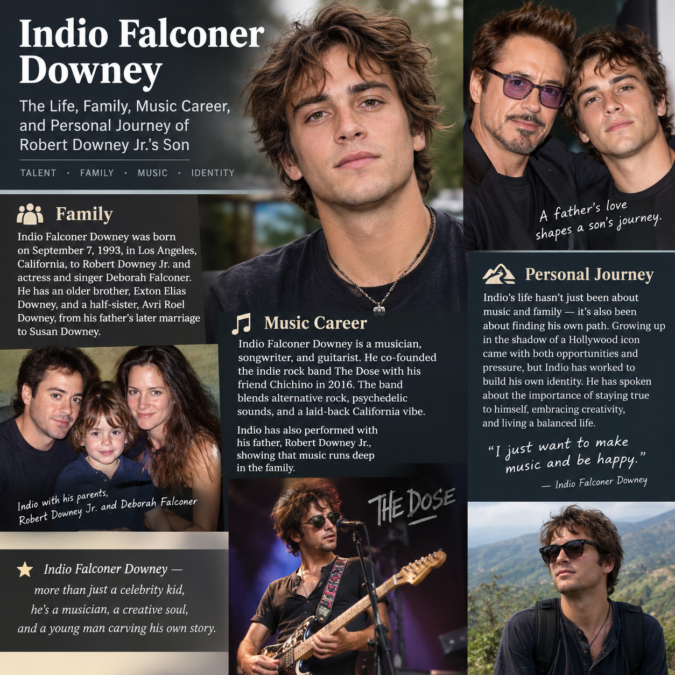
Born in September 1993, Indio grew up surrounded by the entertainment industry through both of his parents. His father became internationally recognized for his acting, while his mother, Deborah Falconer, built a career as a singer, songwriter, model, and actress. These artistic influences helped create an environment in which music, performance, and creative expression were familiar parts of everyday life. Nevertheless, growing up in a well-known family also meant that public curiosity about Indio often began with his surname rather than his own accomplishments.
Today, Indio Falconer Downey is particularly interesting to readers who follow celebrity families, alternative music, and the next generation of entertainers. His experience as a musician demonstrates how personal interests can develop into a creative career even when expectations are shaped by a famous parent. Understanding his background requires looking at his childhood, his relationship with his family, his musical development, his acting experiences, and the personal challenges that have influenced his journey.
Who Is Indio Falconer Downey?
Indio Falconer Downey is the eldest child of Robert Downey Jr. and Deborah Falconer. He was born on September 7, 1993, in California, and he has pursued creative work in both music and acting. Although his father’s fame has made him a recognizable name in entertainment news, Indio’s professional interests have largely centered on music, particularly alternative rock and related guitar-based styles.
Unlike celebrities who immediately pursue a career in mainstream entertainment, Indio has explored different artistic directions over time. His musical projects have included the rock duo The Dose and later releases under his own name. These projects demonstrate his interest in songwriting, performance, and creating music that communicates complicated emotions rather than simply producing commercially polished material.
The name Indio Falconer Downey frequently appears in online searches because people want to understand his connection to the Downey family. Readers may also be interested in his age, parents, career, music releases, and personal development. These questions are understandable, but his professional identity deserves attention in its own right.
His story illustrates an important distinction between having access to the entertainment industry and developing the skills necessary to participate in it. A famous surname can introduce an artist to public attention, but musical ability, dedication, and individual expression are what help create a recognizable artistic voice.
Early Life and Childhood
Indio Falconer Downey spent his early years in a family connected to film, music, and performance. His father was already an established actor, while his mother had experience in several artistic fields. Growing up in such an environment meant that creativity was not an unfamiliar concept. Music and acting were part of the professional world surrounding him, giving him early exposure to different forms of artistic expression.
Children raised in entertainment families can experience a distinctive combination of opportunities and pressures. They may encounter creative professionals, recording environments, film productions, and artistic discussions earlier than many of their peers. At the same time, public attention can create expectations about what they should accomplish and how they should behave.
For Indio, the presence of two artistically active parents provided a natural connection to music and performance. His mother’s musical background was especially relevant to his later interests. Rather than treating music solely as a hobby, he eventually began learning instruments and experimenting with songwriting, developing the foundation for his own creative direction.
However, it would be inaccurate to assume that his childhood automatically determined his future. People develop their interests through a combination of environment, personality, experiences, and personal decisions. Indio’s later musical work reflects an individual engagement with the genres and themes that interested him.
His early life is therefore best understood as the beginning of a longer creative journey rather than a simple story about inheriting fame. The opportunities associated with his family background formed one part of that journey, while his later decisions helped shape the artist he became.
Indio Falconer Downey’s Parents
Robert Downey Jr. and His Hollywood Career
Robert Downey Jr. is one of the most recognizable actors of his generation. Over a career spanning several decades, he has appeared in independent dramas, comedies, action films, and major studio productions. His performances as Tony Stark, also known as Iron Man, made him a central figure in the Marvel Cinematic Universe and introduced him to audiences around the world.
His career has included remarkable professional achievements as well as widely reported personal difficulties. Over time, he rebuilt his professional life and became known for his versatility, humor, and ability to portray complex characters. His career offers a prominent example of how an entertainer can experience major setbacks and later regain professional momentum.
For Indio, having a father with such a public career inevitably influenced how audiences viewed his own activities. Media coverage frequently introduces him as Robert Downey Jr.’s eldest son before discussing his music. That connection is a factual part of his biography, but it does not fully explain his artistic interests or individual accomplishments.
Robert’s experience with recovery and personal change has also made discussions of family, support, and growth particularly meaningful in public accounts of the Downey family. Nevertheless, it is important not to assume that every member of a family experiences the same circumstances or responds to them in identical ways.
Indio’s career should therefore be evaluated through his own creative projects, performances, and artistic development. His father’s achievements provide useful family context, but they are not a substitute for understanding Indio’s independent work.
Deborah Falconer and Her Artistic Influence
Deborah Falconer is an American singer, songwriter, model, and actress. Her work in entertainment established a creative background that complements Robert Downey Jr.’s acting career. Through her music and other artistic activities, she developed an identity that was not limited to her relationship with a famous actor.
Her connection to music is particularly relevant when discussing Indio Falconer Downey. Growing up with a mother who had experience in songwriting and performance meant that music was connected to the family’s broader artistic environment. This background offers context for Indio’s eventual interest in guitar, singing, and composing songs.
Music often becomes meaningful through everyday exposure. A child who hears recordings, attends performances, or watches a parent work creatively may begin to see artistic expression as an accessible way to communicate ideas and emotions. That does not guarantee a future career, but it can help create the conditions in which an interest develops.
Indio’s later interviews have described his interest in learning songs by established rock musicians and eventually writing material of his own. These experiences suggest that his musical identity grew through both family influence and personal engagement with the music he admired.
Deborah Falconer’s career should not be treated simply as a footnote to her son’s biography. Her own artistic background forms an important part of the family history that helps explain why creative expression became a significant part of Indio’s life.
His Parents’ Relationship and Family Background
Robert Downey Jr. and Deborah Falconer married in 1992, and Indio was born the following year. Their relationship later experienced difficulties, and they separated in the late 1990s. Their divorce was finalized in 2004, bringing their marriage to a legal conclusion after a period of separation.
Public accounts of the family’s history have frequently discussed the challenges Robert faced during that period of his life. However, the details of a family’s private experiences should be approached carefully. Headlines can simplify complicated relationships, and outsiders rarely possess a complete understanding of what family members experienced behind closed doors.
For Indio, growing up while his parents navigated separate lives was part of his personal history. Such circumstances can influence family relationships, but it would be inappropriate to make unsupported assumptions about his private feelings or the exact effect of those experiences on his development.
What can be said is that both parents had established careers in creative fields. Their professional lives placed them within the entertainment world, while Indio eventually chose to explore his own artistic interests. His path has included music, acting, and personal growth rather than a straightforward attempt to duplicate either parent’s career.
The family story also illustrates why celebrity biographies should balance public information with respect for personal boundaries. Readers can learn about documented milestones without treating private experiences as entertainment or assuming that every aspect of a person’s life is available for public judgment.
Indio Falconer Downey’s Siblings
Indio is Robert Downey Jr.’s eldest child. His father later married producer Susan Downey, and they welcomed two children, Exton Elias Downey and Avri Roel Downey. As a result, Indio has two younger paternal half-siblings.
Susan Downey has built a successful career as a film producer and has worked with Robert on numerous projects. Their household represents another branch of the family’s connection to the entertainment industry, although the children have different ages and experiences.
Indio’s position as the eldest sibling makes him an important part of the extended Downey family. However, it is best not to speculate about private sibling relationships or assume that their lives are identical simply because they share a father.
Celebrity families often attract attention because audiences enjoy learning how relatives interact and whether younger family members will pursue similar careers. Yet each person develops at a different pace and may have different ambitions. A family connection can be meaningful without defining someone’s entire future.
For Indio, music has remained an important part of his public identity. His work offers a way to understand his personal interests beyond the fact that he belongs to a well-known family.
How Indio Falconer Downey Discovered Music
Music became a significant part of Indio’s life while he was growing up. In interviews, he has explained that he began singing and playing guitar as a young teenager. He initially wanted to learn songs by musicians he admired, gradually moving from playing existing material toward writing original songs.
This progression is common among developing musicians. Learning another artist’s music provides an opportunity to understand chord structures, melodies, rhythm, and the relationship between vocals and instruments. Over time, musicians may begin experimenting with these elements and discovering how to express their own ideas.
Indio’s early musical interests included classic rock and alternative bands. He has discussed the influence of songs such as Led Zeppelin’s “Stairway to Heaven,” Nirvana’s “Smells Like Teen Spirit,” and The White Stripes’ “Seven Nation Army.” These tracks represent different approaches to guitar music, from expansive classic rock arrangements to raw grunge and stripped-down alternative rock.
The appeal of these artists lies partly in their distinctive musical identities. They demonstrate that a song can be powerful without relying on elaborate production or complicated arrangements. A memorable guitar riff, an expressive vocal performance, or an emotionally direct lyric can be enough to make a lasting impression.
As Indio continued developing his skills, music became more than a way to reproduce songs he enjoyed. It became a medium for expressing his own experiences. That shift from imitation to original songwriting marked an important step toward building an independent artistic identity.
Indio Falconer Downey’s Musical Style
Indio Downey’s music is commonly associated with alternative rock, pop punk, and grunge-influenced guitar music. His work draws on the energy of punk while incorporating the heavier guitar textures and emotional intensity associated with alternative rock.
His recordings often emphasize guitar riffs, live-sounding drums, expressive vocals, and direct songwriting. Rather than relying entirely on smooth production, this approach leaves room for rough edges and a sense of immediacy. Such qualities have long been central to rock music, especially genres that value emotional honesty and independence.
Alternative rock covers a broad range of sounds, and Indio’s work reflects that variety. Some songs lean toward energetic, distorted guitar arrangements, while others explore more melodic or reflective territory. This contrast can make a collection of songs feel more personal than a release built around a single repeated formula.
His musical identity also reflects the influence of artists who combine catchy melodies with darker lyrical themes. A song may sound energetic on the surface while addressing heartbreak, uncertainty, regret, or personal struggle. This contrast between musical intensity and emotional vulnerability is a familiar feature of punk and grunge traditions.
It is important not to describe Indio as a copy of the musicians who influenced him. Every developing artist begins with references, but the creative challenge is to combine those influences into something individual. His work demonstrates an effort to use familiar rock traditions while communicating his own experiences.
The Influence of Punk Rock and Grunge
Punk rock and grunge have played an important role in shaping the sound associated with Indio Falconer Downey. Both traditions have challenged conventional ideas about polished performance, commercial expectations, and what popular music should sound like.
Punk developed a reputation for directness, energetic performances, and a preference for authenticity over elaborate presentation. Grunge brought together heavy guitar sounds, alternative rock structures, and lyrics that frequently explored alienation, uncertainty, and emotional conflict. Their histories differ, but both genres have influenced generations of musicians.
Indio has identified artists such as Nirvana, Pixies, Weezer, The Sex Pistols, and Queens of the Stone Age among his influences. These musicians approach songwriting in different ways, offering a broad range of ideas about melody, rhythm, distortion, and lyrical expression.
Nirvana helped bring grunge into the mainstream through a sound that combined powerful guitar arrangements with memorable melodies and emotionally charged lyrics. Pixies became influential for their unusual dynamics and ability to shift between quieter passages and explosive choruses. Weezer demonstrated how alternative rock could combine guitar-heavy arrangements with accessible pop melodies.
The Sex Pistols represent a more confrontational punk tradition, while Queens of the Stone Age have explored heavy, rhythmic, and sometimes hypnotic approaches to rock. Listening to these artists provides context for the musical landscape in which Indio developed his own style.
For listeners, recognizing these influences can make his recordings easier to understand. At the same time, influences are only a starting point. The most meaningful question is how an artist uses those traditions to express individual experiences and create songs that listeners remember.
The Dose: An Early Chapter in His Music Career
One of the notable early projects associated with Indio Falconer Downey was The Dose, a rock duo he formed with drummer Ralph Alexander. The group gained attention for its guitar-driven sound and clear interest in the alternative rock and grunge traditions of earlier decades.
The duo’s format offered a relatively direct way to make music. With guitar, vocals, and drums at the center, the arrangement left little room to hide behind elaborate instrumentation. This kind of setup can place greater responsibility on the performers to create energy through timing, dynamics, riffs, and the relationship between the instruments.
The Dose attracted music-media attention partly because of Indio’s family connection, but the project was also discussed in terms of its musical influences. Coverage of the group highlighted similarities to bands such as Nirvana and Alice in Chains, whose work helped establish the sound of grunge.
For a developing musician, playing in a band offers lessons that are difficult to acquire through songwriting alone. Rehearsals require consistency, performances demand concentration, and collaboration teaches musicians how to balance personal ideas with the needs of a group.
Working with another musician also creates opportunities to experiment. A drummer can change the feel of a guitar riff, while a guitarist can alter the direction of a song through its rhythm or structure. These interactions can help a developing artist become more confident and flexible.
The Dose represents an important stage in Indio’s creative history because it demonstrates that his musical interests existed before his later solo releases. It also shows how he began translating his admiration for alternative rock into original performance and recorded music.
Moving From a Band Toward Individual Expression
Working in a band can provide a strong foundation, but musicians sometimes discover that they want more control over songwriting, production, or the emotional direction of their recordings. Indio’s later work under his own name reflects a move toward a more individual approach.
A solo project does not necessarily mean working alone. Musicians often collaborate with producers, instrumentalists, and other creative professionals while maintaining a personal vision for the finished songs. The distinction is that the project can be organized around one artist’s songwriting and artistic priorities.
In interviews surrounding his debut EP, Indio discussed learning more about his own writing process and becoming more comfortable creating lyrics. He also described working with producers as a way to develop the sound of his recordings and make the production more dynamic.
This kind of development is rarely immediate. Songwriting involves repeated experimentation, revisions, and decisions about which ideas deserve to remain in a song. A line that seems meaningful in a notebook may not work when sung, and a guitar arrangement may need to change to support the melody.
Indio’s movement toward individual releases therefore represents more than a change in credit. It reflects an ongoing effort to understand what he wants his music to communicate and how he can express those ideas effectively.
For audiences, solo work can offer a closer view of an artist’s personality. It creates space for listeners to hear recurring themes, understand the artist’s influences, and follow the evolution of a musical voice over time.
Cigarettes in Bed: His Debut EP
Cigarettes in Bed is a significant release in Indio Downey’s musical development. The EP was released in January 2024 and introduced listeners to a collection of songs shaped by alternative rock, pop punk, emotional vulnerability, and guitar-heavy arrangements.
The project received attention from music publications because it presented Indio as an artist developing his own sound rather than simply appearing in coverage of his famous father. Its songs explored themes associated with relationships, heartbreak, addiction, recovery, and the complicated process of moving forward after difficult experiences.
An EP can be an effective format for an emerging musician. It offers enough space to explore a few connected ideas without requiring the scope of a full-length album. It also allows the artist to experiment with different arrangements and establish a recognizable musical direction.
For Indio, Cigarettes in Bed provided an opportunity to bring several years of songwriting experience into a focused release. The recordings combined the rawness of alternative rock with melodic elements that made the songs accessible to listeners who enjoy both punk energy and reflective songwriting.
The title itself suggests intimacy and the emotional complexity of relationships. Rather than treating romance as a purely happy experience, the project explores how relationships can become connected to loneliness, dependence, nostalgia, and the desire for comfort.
The EP’s significance lies in its combination of musical influences and personal themes. It offers a clearer picture of the subjects Indio wants to explore as a songwriter and establishes a foundation for understanding his later artistic development.
Dume: A Song About Emotional Struggle
“Dume” is one of the songs associated with Indio Downey’s early solo releases. The track uses a forceful alternative rock arrangement to communicate frustration, emotional confusion, and the feeling of being caught in an unhealthy pattern.
The song’s guitar-driven sound reflects the influence of grunge and heavier alternative rock. Its intensity supports lyrics centered on difficult feelings rather than presenting the listener with a simple, uplifting message.
In discussing the song, Indio connected its emotional atmosphere with experiences such as rejection and feeling unsuccessful. Those themes are familiar to many listeners because they describe moments when personal expectations and reality do not seem to match.
Music can give such experiences a form that is easier to understand. A difficult emotion that feels vague in everyday life can become more recognizable when it is expressed through a melody, a lyric, or a repeating guitar pattern.
“Dume” also demonstrates the value of contrast in songwriting. A heavy arrangement can make vulnerability feel more powerful, while an expressive vocal performance can give a loud instrumental passage an intimate quality.
For listeners interested in Indio Falconer Downey, the song provides a useful introduction to his approach. It shows how he combines alternative rock conventions with themes drawn from emotional experience, creating music that feels personal without requiring listeners to share every detail of his life.
Plastic Rainbow and the Role of Nostalgia
“Plastic Rainbow” is another important song from Indio Downey’s solo work. Although the track carries an energetic alternative rock sound, its meaning is more complicated than a straightforward celebration of romance.
Indio has explained that the song relates to past addiction and the nostalgia associated with memories that once felt comforting or happy. This creates a contrast between the music’s lively energy and the emotional uncertainty of looking back on a difficult period.
Nostalgia can be complicated because memories rarely preserve every detail of an experience. A person may remember the excitement, companionship, or temporary relief associated with a particular time while gradually overlooking the problems that accompanied it.
Songwriting can explore that tension without pretending that the past was entirely good or entirely bad. A melody may evoke warmth while the lyrics reveal regret, allowing the listener to experience conflicting emotions at the same time.
“Plastic Rainbow” demonstrates how Indio uses personal reflection as a starting point for creative expression. The song does not simply describe an event; it explores the way memory can change the meaning of an experience over time.
This approach is consistent with alternative rock traditions in which accessible melodies often carry lyrics about alienation, loss, and uncertainty. The contrast allows the song to connect with listeners who appreciate music that sounds energetic while addressing emotionally complicated subjects.
The Other Side and the Theme of Moving Forward
“The Other Side” is another song associated with Cigarettes in Bed. Its place within the broader collection helps illustrate the emotional movement that Indio explored through his songwriting.
A project that addresses difficult experiences can become repetitive if every song communicates the same feeling. By exploring different emotional perspectives, a songwriter can create a more complete picture of a personal journey. Anger, sadness, affection, acceptance, and hope may all belong to the same story.
The themes associated with “The Other Side” fit into a wider interest in overcoming suffering and learning to accept reality. Rather than presenting change as an instant transformation, the music suggests that personal development can involve a series of decisions and shifts in perspective.
This is one reason emotionally direct rock music continues to appeal to listeners. The genre can provide a space for frustration without requiring every song to end happily. It can acknowledge pain while leaving room for the possibility that a person may eventually move beyond it.
For Indio, this kind of songwriting creates a link between the sound of his music and the experiences he has chosen to explore. It allows the recordings to function as more than entertainment, offering listeners a way to reflect on their own emotions.
The broader message is that personal growth does not require pretending that difficult experiences never happened. Sometimes moving forward begins with acknowledging the past and recognizing that it does not have to determine every future decision.
Songwriting and Creative Process
Songwriting requires more than having an interesting story to tell. A musician must find a way to transform an idea into a structure that works musically, balancing lyrics, melody, rhythm, and arrangement.
Indio has described using free writing and meditation to help develop his creative ideas. These methods can give a songwriter room to explore thoughts before deciding which details belong in a finished song.
Free writing involves putting ideas on paper without immediately judging their quality. This can help reveal emotional patterns, images, and phrases that might otherwise be lost while trying to produce polished lyrics too early.
Meditation can serve a different purpose by encouraging concentration and helping a person approach a task with greater patience. Neither method guarantees a successful song, but both can create conditions that make creative work easier.
Indio has also discussed how the music and lyrics do not always arrive in the same order. Sometimes a melody comes first, while at other times a lyrical idea provides the starting point. This flexibility is common among songwriters, whose methods often change depending on the project.
Recording a song acoustically can also help an artist identify its basic structure before adding heavier production. If a melody and lyric work with a simple guitar arrangement, the musician has a stronger foundation for developing the finished recording.
These details offer a useful glimpse into Indio’s artistic process. They suggest that his work depends on reflection, experimentation, and revision rather than inspiration alone.
Addiction, Recovery, and Personal Growth
Addiction and recovery are among the most serious themes discussed in connection with Indio Falconer Downey. His music has explored difficult experiences associated with substance use, emotional distress, and the process of finding healthier ways to respond to painful feelings.
In 2014, Indio was arrested on a cocaine-possession charge in California. The incident received widespread attention because of his father’s fame. Robert Downey Jr. publicly expressed support for his son and emphasized the family’s commitment to helping him.
Such events can attract sensational headlines, but addiction is a complicated issue that should not be reduced to a single incident or used as a permanent definition of a person’s character. Substance-use problems can involve physical, emotional, and social factors, and recovery may require sustained support and changes in behavior.
Indio’s later interviews have discussed sobriety and the role music played in helping him manage difficult emotions. He has described listening to music during periods when he felt depressed or angry and using creative expression as an alternative to suppressing those feelings.
It is important to distinguish between what he has publicly discussed and what remains private. His songs and interviews provide insight into certain experiences, but they do not offer a complete account of his personal life or health.
His story nevertheless highlights a meaningful role that art can play in recovery. Music cannot replace professional treatment or other appropriate support, but it can help people recognize emotions, express difficult experiences, and feel less alone.
For readers, the most constructive lesson is that personal setbacks need not become the only story told about someone. People can change, develop healthier habits, and pursue meaningful work while continuing to learn from their experiences.
The Importance of Family Support

Family support can be valuable when a person faces difficult circumstances, although every family’s experience is different. In Indio’s case, Robert Downey Jr.’s public response to his son’s legal trouble demonstrated that he intended to support him rather than publicly abandon him.
Support does not mean ignoring problems or pretending that harmful behavior has no consequences. In many circumstances, meaningful support involves encouraging accountability while helping a person access the resources needed to make better decisions.
The Downey family’s public history has also included discussions of recovery and personal change. Robert has spoken openly about his own difficult years and the transformation that followed. His experiences may provide useful context for understanding why family support has appeared in public accounts of Indio’s challenges.
However, it would be unfair to assume that a parent’s experience automatically determines a child’s recovery. People have different circumstances, needs, and responses to treatment. Each person’s progress must be understood individually.
Indio’s continued engagement with music offers one example of how creative work can become part of a person’s broader development. His songwriting provides a way to address complicated emotions, while his professional projects create opportunities to build skills and maintain artistic goals.
Ultimately, family support is most meaningful when it respects an individual’s responsibility for personal decisions. Encouragement, patience, and practical assistance can coexist with the expectation that someone must actively participate in their own growth.
Indio Falconer Downey’s Acting Career
Although music is a major part of Indio’s public identity, he has also appeared in film and other screen projects. His early acting credit includes Kiss Kiss Bang Bang, the film starring Robert Downey Jr. and Val Kilmer.
In the film, Indio appeared as a younger version of the character played by his father. The role was a natural point of connection between his family background and the entertainment industry, but it should not be mistaken for evidence that his entire career has focused on acting.
His later screen-related work and appearances demonstrate that he has remained connected to film and television while pursuing music. These activities reflect the overlap that often exists between creative disciplines, particularly for people raised in an entertainment environment.
Acting and music require different technical skills, but both involve interpretation and communication. An actor uses dialogue, movement, and expression to portray a character, while a musician communicates through sound, performance, and songwriting.
Indio’s experience with both fields gives him more than one possible direction for future work. Nevertheless, it is important to evaluate each project individually rather than assuming that family connections guarantee a particular level of success.
For readers who know him primarily through his father, his acting credits provide another aspect of his professional background. His musical projects, however, remain especially important to understanding the creative identity he has developed for himself.
New Acting Opportunities and Future Screen Projects
Recent entertainment reporting has described Indio Downey as attached to Love in Vein, an independent drama based on Ryan Leone’s novel Wasting Talent. According to that reporting, he is expected to portray Damien, a musician whose life involves addiction, relationships, and destructive behavior. Filming has been reported as planned for 2027.
The project would represent a significant opportunity for Indio to take on a more substantial acting role. Rather than appearing briefly in a film connected to his family, a leading role would require him to carry a larger portion of the story and sustain a character across the film’s narrative.
The reported subject matter also overlaps with themes that have appeared in his music. His experience as a songwriter may help him understand aspects of a character whose life revolves around music, although an actor’s personal background does not automatically determine how effectively a role will be performed.
Because the production is still in the planning stage according to the available report, details such as its eventual release date, final cast, and completed filming should be treated as unconfirmed until the filmmakers provide further announcements.
Independent films can offer actors opportunities to explore complicated characters and work with creative teams outside the largest studio productions. Their success depends on many factors, including the script, direction, performances, production, and audience response.
For Indio, the project could become another step in exploring the relationship between music and acting. Its eventual significance will be clearer when the film moves beyond its reported development stage and becomes available for audiences to evaluate.
His Connection to Downey’s Dream Cars
Indio has also been connected to Downey’s Dream Cars, a series involving Robert Downey Jr.’s interest in automobiles and environmental technology. The project combines automotive restoration with discussions about how classic cars might be adapted to reduce their environmental impact.
The series provides another example of how members of the Downey family have appeared together in projects that extend beyond traditional acting roles. It also illustrates the way modern entertainment personalities can combine professional interests with documentary-style programming.
For Indio, participation in a family-related television project represents a different kind of screen experience from acting in a scripted film. Reality and documentary formats often emphasize personal interests, activities, and interactions rather than a character’s fictional storyline.
Such appearances can introduce viewers to family members who do not regularly pursue mainstream celebrity careers. They may also create opportunities for audiences to understand how relatives participate in a shared project while maintaining separate professional interests.
However, a television appearance should not be confused with a complete account of a person’s career. Indio’s music and independent creative work remain important when evaluating his broader professional direction.
The series adds another detail to his public biography, but it does not define his entire identity. As with his other activities, its significance is best understood as one part of a varied creative life.
The Influence of Robert Downey Sr. and the Downey Family Legacy
Indio Falconer Downey is also part of a family with a long history in filmmaking. His paternal grandfather, Robert Downey Sr., was a filmmaker known for independent and unconventional work. His films helped establish a distinctive family connection to creative experimentation and alternative approaches to entertainment.
Robert Downey Sr.’s career was different from the large-scale studio work associated with his son. His filmmaking often challenged conventional storytelling and demonstrated a willingness to experiment with form, humor, and social commentary.
That history provides useful context for the family’s broader artistic environment. Creative traditions are not passed down in a simple, automatic way, but exposure to different approaches can influence the questions an emerging artist asks about their own work.
Indio’s interest in alternative rock reflects a different medium, yet it similarly involves drawing on established traditions while seeking an individual voice. Guitar-driven music, like independent filmmaking, can offer room for experimentation outside conventional commercial expectations.
The family legacy is therefore more complex than a list of famous relatives. It includes different generations working in different artistic forms, each with their own priorities and professional challenges.
For Indio, the most meaningful way to engage with that legacy may be to continue developing work that reflects his own experiences. A family history can provide inspiration, but it does not remove the need for individual effort and creative judgment.
What Makes Indio Falconer Downey’s Story Interesting?
Indio’s story attracts attention because it combines celebrity-family connections with an independent creative direction. Readers naturally want to know what the children of famous entertainers do, but his musical development offers a more substantial subject than family curiosity alone.
His journey also illustrates the difficulty of building an identity when the public already associates a person with a highly recognizable surname. Every new project may be interpreted through the achievements of a parent, even when the work itself follows a different artistic direction.
Music offers Indio a way to establish his own identity. His releases demonstrate a preference for alternative rock, emotionally direct lyrics, and themes that reflect personal experiences. These elements create a foundation for audiences to evaluate his work on its own terms.
His public history also includes challenges, making his journey more complicated than a conventional celebrity biography. Discussions of recovery, personal growth, and artistic expression can encourage readers to think about how people move forward after difficult periods.
It is equally important not to romanticize those challenges. Addiction and emotional distress are serious issues, and they should not be treated as necessary ingredients for artistic success. Indio’s experiences are part of his public story, but they do not need to define every aspect of his work.
What makes his journey worth following is the combination of creative ambition and ongoing development. His career is still evolving, and the projects he chooses in the future will help determine how audiences understand his contribution to music and entertainment.
Indio Falconer Downey’s Public Image
Public perception of Indio Falconer Downey is strongly influenced by his family connection. Entertainment articles frequently introduce him through Robert Downey Jr., which can help readers understand why his name attracts attention but can also overshadow his own accomplishments.
This pattern is common among the children of celebrities. Their family background often becomes the first detail mentioned in news coverage, while their professional interests receive less attention. The result can be an incomplete public image that focuses on ancestry rather than individual work.
Indio’s music provides a way to move beyond that narrow perspective. Listening to his releases allows audiences to consider his songwriting, vocal delivery, instrumental arrangements, and artistic influences without relying entirely on celebrity headlines.
His public image is also shaped by his willingness to discuss personal themes in interviews. When musicians talk about the experiences behind their songs, listeners gain context for understanding their work. At the same time, artists retain the right to keep parts of their private lives outside public discussion.
A balanced view of Indio recognizes both realities. He is the son of a famous actor, and that connection is part of his biography. He is also an artist with his own projects, interests, and creative decisions.
As his career develops, the most useful measure of his public identity will be the work he produces and the way audiences respond to it, rather than the assumptions attached to his family name.
The Challenges of Growing Up in a Famous Family
Growing up in a famous family can provide access to professional networks, creative environments, and opportunities that may be difficult for others to obtain. However, it can also create unusual pressure, especially when the public compares a younger family member with an internationally recognized parent.
One challenge is the expectation that a child will follow the same career path. When a parent is a celebrated actor, audiences may expect the child to become an actor as well. When the child chooses music or another profession, that decision can be interpreted as surprising even when it reflects genuine personal interests.
Another challenge is that ordinary mistakes can receive disproportionate attention. A private difficulty may become a headline, and a person may struggle to move beyond an incident that continues to appear in online searches.
These circumstances can make the process of establishing an independent identity more complicated. Creative work becomes one way to demonstrate individual interests, while consistency and continued development help build a professional reputation over time.
Indio’s experience illustrates why celebrity-family stories deserve more nuance than the labels often applied to them. His background is relevant, but it does not eliminate the need to develop skills, make decisions, and learn from experience.
The most constructive perspective is to recognize both the advantages and the pressures of a famous family without assuming that either one guarantees a particular outcome.
His Approach to Relationships and Emotional Honesty in Music
Relationships are among the recurring subjects in Indio Downey’s songwriting. His songs have explored attraction, heartbreak, dependence, uncertainty, and the ways emotional experiences can influence behavior.
Writing about relationships can be difficult because feelings are often contradictory. A person may miss someone while recognizing that the relationship was unhealthy, or remember a happy moment while understanding that the wider situation caused pain.
Music offers a way to express these contradictions without resolving every question. A lyric can preserve uncertainty, and an arrangement can communicate a feeling that is difficult to describe in ordinary conversation.
Indio has discussed the emotional vulnerability associated with falling in love and the way relationships can affect a person’s sense of control. Such themes are common in popular music, but their meaning depends on the details and perspective of each song.
His approach also reflects a broader principle of songwriting: honesty can make a song more emotionally convincing. Listeners do not necessarily need to share the songwriter’s experiences to recognize the feelings being expressed.
For Indio, relationship themes help connect personal reflection with the traditions of alternative rock. The result is music that can be energetic in sound while remaining thoughtful about the complicated nature of human connections.
The Role of Music in Healing and Self-Understanding
Music can serve several purposes in a person’s life. It can provide entertainment, create social connections, support concentration, and offer a way to express emotions that are difficult to communicate directly.
Indio has described music as an important part of his own process of healing, growth, and transformation. His comments suggest that listening to artists he admired helped him navigate difficult periods and encouraged him to express emotions through songwriting rather than simply pushing them aside.
This idea is familiar to many musicians and listeners. A song can give shape to sadness or anger, helping a person recognize that complicated feelings are not unique to them. The experience of hearing an artist describe a similar struggle can create a sense of connection.
Creating music can also encourage reflection. Turning an experience into lyrics requires a person to decide what happened, how it felt, and which details communicate its meaning most clearly. That process may reveal patterns or perspectives that were not obvious at first.
However, music is not a universal solution to every problem. It can complement healthy coping strategies, but serious emotional or substance-use difficulties may require professional support and other forms of care.
The value of Indio’s story lies in its emphasis on creative expression as one possible part of personal growth. His music shows how difficult experiences can become material for reflection without suggesting that suffering is necessary for creativity.
Indio Falconer Downey’s Musical Influences Beyond Grunge
Although grunge and punk are important references in Indio’s work, his influences extend into a wider alternative rock landscape. Different bands offer different lessons about melody, arrangement, production, and the relationship between emotional intensity and accessibility.
Pixies are known for their dynamic contrasts, often shifting between quieter passages and explosive sections. This approach can make a song feel unpredictable while giving its chorus greater impact.
Weezer offers a different model by combining alternative rock guitars with memorable pop melodies. Their music demonstrates that catchy songwriting and a distinctive guitar sound can work together rather than compete.
Queens of the Stone Age explore heavy rhythms, unusual guitar textures, and arrangements that can feel both forceful and hypnotic. The Sex Pistols represent a more direct punk tradition, emphasizing energy and attitude over elaborate musical ornamentation.
Nirvana combines many of the qualities that make alternative rock appealing: powerful guitar sounds, accessible melodies, and lyrics that communicate emotional discomfort without always explaining it completely.
These influences give Indio a broad creative vocabulary. They allow him to draw on different traditions depending on the emotional and musical needs of a particular song.
The important point is not simply identifying which famous bands sound similar to his work. It is understanding how musicians learn from the artists they admire and then use those lessons to develop their own approach to songwriting.
Why Alternative Rock Continues to Appeal to New Musicians
Alternative rock remains attractive to emerging musicians because it offers a balance between structure and freedom. Songs can have memorable melodies and familiar arrangements while still allowing room for distortion, unconventional sounds, and emotionally complex lyrics.
The genre also supports different approaches to production. Some recordings emphasize clarity and polish, while others preserve the roughness of a live performance. Both methods can be effective when they serve the song’s emotional purpose.
For a developing artist, alternative rock provides a broad foundation rather than a single set of rules. A musician can combine punk energy with pop melodies, grunge textures with reflective lyrics, or heavy instrumentation with quieter passages.
This flexibility helps explain why the genre continues to influence younger performers. Its traditions offer a recognizable musical language, but artists can adapt that language to different experiences and modern recording methods.
Indio Falconer Downey’s work fits within this broader tradition. His music draws on the guitar-driven sound of earlier bands while exploring personal themes that remain relevant to contemporary listeners.
The continuing appeal of alternative rock also reflects the importance of authenticity. Audiences often respond to music that feels connected to a real emotional perspective, even when the production is sophisticated or the song follows a familiar structure.
For Indio, the genre offers a practical way to combine his influences with his own experiences, allowing him to develop a sound that feels connected to rock history without being limited to it.
How Indio Balances Family Recognition With His Own Career
A famous surname can create immediate recognition, but it can also make it difficult for audiences to separate an artist’s work from their family background. Indio Downey has experienced this challenge as the son of Robert Downey Jr.
His music career offers a way to establish an independent professional identity. Recordings, performances, interviews, and collaborations allow listeners to understand what he does as an artist rather than relying only on family connections.
This process takes time. A single release rarely establishes a lasting reputation, and public attention can fluctuate according to events that have little to do with the quality of the work. Consistent creative development is often more important than a brief moment of visibility.
Indio’s musical projects demonstrate an ongoing commitment to songwriting and performance. His move from a band project toward individual releases also suggests an interest in exploring his own artistic priorities.
At the same time, there is no need to pretend that his family background is irrelevant. His surname is part of his biography, and public curiosity about his father is understandable. The goal is to maintain a distinction between context and judgment.
A balanced approach recognizes that family connections may influence opportunities and public attention while leaving room for the artist’s own work to be evaluated fairly.
What Fans Can Learn From His Creative Journey
Indio Falconer Downey’s career offers several useful lessons for people interested in music, creative work, and personal development. One is the value of learning from established artists without assuming that imitation is the final goal.
Musicians often begin by playing songs they admire. This stage teaches technique, rhythm, structure, and musical vocabulary. Originality develops when those skills are used to communicate something personal rather than simply reproduce another artist’s sound.
Another lesson concerns persistence. Developing a musical identity requires repeated practice, experimentation, and a willingness to revise work that does not meet expectations. Progress often happens gradually rather than through a single breakthrough.
His songwriting also illustrates the value of emotional honesty. Personal experiences can provide useful material for creative work when the artist takes time to understand them and express them thoughtfully.
Finally, his story highlights the importance of seeing people as more than their most publicized experiences. A person’s life may include mistakes, difficult periods, achievements, and ongoing efforts to change. No single event necessarily captures the full picture.
These lessons apply beyond music. Anyone developing a skill or pursuing a creative goal can benefit from learning the basics, finding influences, practicing consistently, and allowing experience to shape their work.
Indio Falconer Downey’s Net Worth and Financial Privacy
Interest in Indio Falconer Downey’s finances is understandable because he belongs to a wealthy and famous entertainment family. However, reliable public information about his personal net worth, earnings, investments, and assets is limited.
Online celebrity websites sometimes publish financial estimates without explaining their methods or providing verifiable documentation. Such figures should not be treated as confirmed facts simply because they appear repeatedly across search results.
Robert Downey Jr. has earned substantial income through acting and other entertainment ventures, but his financial position cannot be used to calculate Indio’s individual wealth. Family resources and personal earnings are different matters.
Indio’s music releases, performances, and acting activities are part of his professional background, but the precise income associated with those projects is not established by the public information discussed here.
It is therefore more accurate to avoid assigning him an unsupported net-worth figure. Financial privacy is common for people who do not regularly disclose their earnings, and a lack of reliable information should not be replaced with speculation.
For readers researching Indio Falconer Downey, the more meaningful focus is his documented creative work and career development rather than estimates that cannot be independently verified.
Where Indio Falconer Downey’s Career Could Go Next
Indio’s future career may involve further music releases, live performances, collaborations, acting projects, or a combination of creative activities. His existing work shows an interest in both recorded music and screen performance, leaving several possible directions open.
In music, future releases could allow him to expand his songwriting and experiment with different production styles. Artists often change their sound as they gain experience, work with new collaborators, and discover which ideas best represent their interests.
Live performance may also remain an important part of his development. Playing in front of an audience can help musicians understand which arrangements work in a live setting and how listeners respond to their material.
Acting offers another possible direction. If the reported Love in Vein project proceeds as planned, it could provide a larger opportunity for him to demonstrate his screen performance skills. However, its production schedule and eventual release remain subject to confirmation from the people involved.
The most important factor will be the quality and consistency of the work he chooses to pursue. A famous family name can generate curiosity, but sustained creative development requires preparation, collaboration, and an ability to respond to challenges.
Indio’s career remains a developing story. Rather than predicting a particular outcome, it is more useful to recognize the different paths available to him and allow future projects to demonstrate how his artistic interests evolve.
Frequently Asked Questions About Indio Falconer Downey
Who Is Indio Falconer Downey?
Indio Falconer Downey is an American musician and actor best known as the eldest son of Robert Downey Jr. and Deborah Falconer. He has pursued alternative rock music, released original songs, and appeared in screen projects.
How Old Is Indio Falconer Downey?
Indio was born on September 7, 1993. As of October 2026, he is 33 years old.
Who Is Indio Falconer Downey’s Mother?
His mother is Deborah Falconer, an American singer, songwriter, model, and actress. Her artistic background is an important part of the family’s creative history.
Does Indio Falconer Downey Make Music?
Yes. Music is a major part of his professional identity. He has been associated with the rock duo The Dose and has released solo material, including the EP Cigarettes in Bed.
What Kind of Music Does Indio Downey Make?
His music is associated with alternative rock, pop punk, and grunge-influenced guitar music. His songs combine guitar-driven arrangements with themes such as relationships, emotional struggles, recovery, and personal growth.
What Is Cigarettes in Bed?
Cigarettes in Bed is Indio Downey’s debut solo EP, released in January 2024. It includes songs that explore complicated emotions and personal experiences through an alternative rock sound.
Has Indio Falconer Downey Acted in Movies?
Yes. His early acting credits include Kiss Kiss Bang Bang, in which he portrayed a younger version of a character played by his father. He has also been associated with other screen projects.
Does Indio Have Any Siblings?
Yes. He has two younger paternal half-siblings, Exton Elias Downey and Avri Roel Downey, from Robert Downey Jr.’s marriage to Susan Downey.
What Happened to Indio Downey in 2014?
In 2014, Indio was arrested on a cocaine-possession charge in California. The incident received public attention, and his father expressed support for him. Discussions of the event should be balanced with respect for personal privacy and recognition that people can change over time.
Is Indio Falconer Downey Still Involved in Music?
His established public work includes music releases and songwriting projects. For the most current information about new songs, performances, or upcoming appearances, readers should consult his official artist channels and current music listings.
Is Indio Falconer Downey Appearing in a New Film?
Entertainment reporting published in October 2026 has described Indio as attached to the independent drama Love in Vein, with filming planned for 2027. Because the project is still in development, readers should look for official production announcements for confirmation of its schedule and final details.
Conclusion
Indio Falconer Downey’s story brings together family legacy, musical ambition, acting experience, and personal growth. As the eldest son of Robert Downey Jr. and Deborah Falconer, he grew up connected to two creative careers. However, his own professional interests have developed through a combination of alternative rock music, songwriting, performance, and selected screen projects.
His work with The Dose and his solo EP Cigarettes in Bed demonstrates a clear interest in guitar-driven music and emotionally honest lyrics. Influenced by artists such as Nirvana, Pixies, Weezer, and The Sex Pistols, he has explored themes involving relationships, nostalgia, recovery, and the challenge of moving forward after difficult experiences.
His public history also shows why celebrity biographies should be approached with balance. Family connections can create opportunities and attention, but they can also overshadow individual achievements. Personal difficulties deserve neither sensational treatment nor permanent judgment, especially when a person’s life continues to develop.
Indio Falconer Downey remains an artist with several possible directions ahead of him. Whether through music, acting, or future collaborations, his ongoing work will determine how his creative identity develops. For readers interested in celebrity families and alternative rock, his journey offers a reminder that a famous background may shape the beginning of a story, but individual choices and creative effort help determine what comes next.
Stay in touch to get more updates & news on New Magazine Here!