
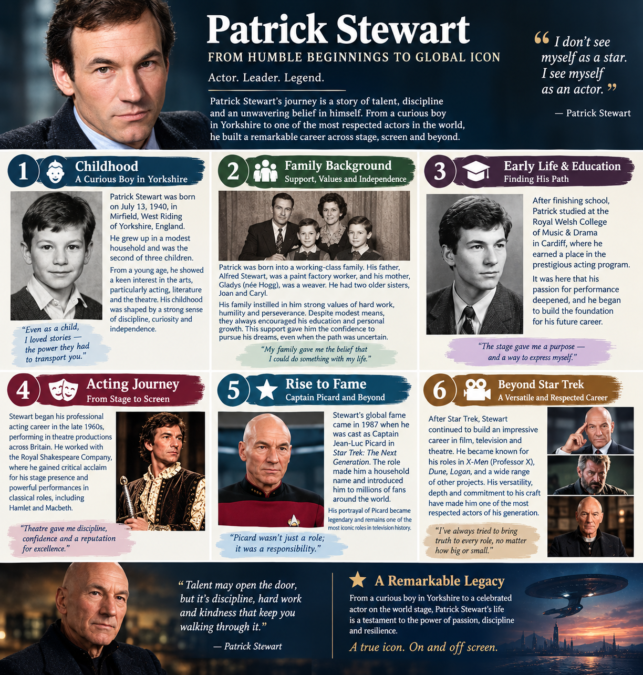

Patrhttps://en.wikipedia.org/wiki/Patrick_StewartickStewart Young:membered as one of the most respected actors in British entertainment history. Known around the world for his powerful performances, distinctive voice, commanding personality, and remarkable stage presence, he built a career that crossed theatre, television, and Hollywood cinema. However, before becoming a familiar face to millions of viewers, Patrick Stewart was a young boy growing up in a working-class family in Yorkshire, England. His early life was very different from the glamorous world that eventually became part of his professional journey.
The story of Patrick Stewart young is particularly interesting because it reveals how an ordinary childhood, a passion for books, encouragement from teachers, and a growing love for theatre helped shape an extraordinary acting career. Long before audiences recognized him as Captain Jean-Luc Picard in Star Trek or Professor Charles Xavier in the X-Men films, Stewart was a schoolboy discovering the power of language, imagination, and performance. His experiences also included personal difficulties that influenced his understanding of people and emotions.
Born in Mirfield, Yorkshire, Stewart did not grow up surrounded by wealth or entertainment opportunities. His family lived a modest life, and his childhood included challenges that he would discuss more openly in later years. Despite these difficulties, he discovered an interest in acting and gradually developed the confidence to pursue it as a profession. His journey demonstrates that success does not always begin with comfortable circumstances or obvious opportunities.
Understanding Patrick Stewart’s younger years provides a deeper appreciation of his achievements. His later performances were shaped not only by professional training but also by the experiences, relationships, and influences that formed his personality. His journey from a small Yorkshire community to the international entertainment industry remains an inspiring example of determination, education, creativity, and personal growth.
Patrick Stewart Young: Birth and Early Childhood
Patrick Stewart was born on July 13, 1940, in Mirfield, a town in West Yorkshire, England. His birth came during a difficult period in British history, when the country was dealing with the effects of the Second World War. The atmosphere of the time influenced many working-class families, including the Stewarts, who lived with limited financial resources and the everyday pressures of postwar Britain.
His mother, Gladys Stewart, worked in the textile industry as a weaver and textile worker. His father, Alfred Stewart, served in the British Army and held the rank of regimental sergeant major. After his military service, Alfred also worked in different occupations, including general labour and postal work. Patrick grew up with two older brothers, Geoffrey and Trevor, in a family where everyday life was shaped by hard work and financial limitations.
Although Stewart’s childhood home was not particularly comfortable, his early surroundings helped develop his awareness of ordinary people and their struggles. The family did not have many of the conveniences that modern households take for granted. In later interviews, Stewart described growing up without facilities such as indoor plumbing, central heating, and running hot water.
His childhood was therefore very different from the lifestyle associated with successful film and television stars. Rather than expensive toys, luxurious holidays, or private entertainment, books, imagination, local activities, and family routines formed much of his early world.
Where Did Patrick Stewart Grow Up?
Although Patrick Stewart was born in Mirfield, his childhood experiences were connected to the wider Yorkshire region, including time spent in Jarrow. His surroundings were characterized by working-class communities, traditional industries, and people who generally understood the importance of earning a living through practical work.
Mirfield was not the kind of place that immediately suggested a future international acting career. It was a relatively small community where people knew one another, and opportunities in professional entertainment were limited. However, the town offered something that became extremely important to Stewart: access to local cultural and dramatic activities.
The community had several amateur theatre groups and organizations that encouraged people to participate in performances. These groups helped make acting seem like a realistic activity rather than something reserved for wealthy or famous individuals. For a young boy interested in stories and imagination, this environment provided an opportunity to explore a different side of life.
Stewart later explained that theatre offered him a place where he could temporarily escape the difficulties of his home environment. When he participated in performances, he could concentrate on characters, dialogue, and storytelling instead of the problems surrounding him.
His connection with Yorkshire remained an important part of his identity throughout his career. Even after achieving international recognition, he frequently discussed his northern English background and the people who helped him develop his interest in acting.
Patrick Stewart’s Family Background
Patrick Stewart’s family played a major role in shaping his early experiences. His mother, Gladys, was a hardworking woman who spent much of her life supporting her family. She worked in the textile industry, an occupation that required dedication and physical effort. Stewart later spoke about his mother with considerable affection and described the difficult circumstances she experienced during her marriage.
His father, Alfred, had a military background and returned from the Second World War carrying experiences that affected his family life. Stewart later discussed the violence that occurred at home and the fear he and his brothers experienced while growing up. He believed his father’s wartime experiences and psychological difficulties contributed to his behavior, although this did not remove the harm caused to the family.
The experiences of witnessing domestic violence became an important subject in Stewart’s later memoir, Making It So. For many years, he rarely discussed the details of his childhood publicly. As he grew older, however, he became more willing to explain how those experiences affected his understanding of relationships, fear, confidence, and emotional well-being.
His two older brothers, Geoffrey and Trevor, were also part of his childhood environment. Growing up with siblings gave Stewart companionship, but the family’s difficult circumstances affected everyone differently. Their experiences were connected by the same household environment, although each brother developed his own path in adulthood.
Stewart’s family background is an important part of understanding his personality. His later success did not erase the difficult experiences of his younger years. Instead, his reflections show how people can carry complicated memories while continuing to build meaningful professional and personal lives.
What Was Patrick Stewart Like as a Young Boy?
As a young boy, Patrick Stewart was interested in reading, language, stories, and the world beyond his immediate surroundings. He did not initially have a clear picture of becoming a major international actor. Like many children, he had different ideas about what his future might look like.
His imagination was encouraged by books and the local library. Reading became an important source of entertainment because his household had limited access to other forms of leisure. Books allowed him to explore different countries, historical periods, characters, and experiences without leaving his hometown.
Stewart was particularly interested in literature. He enjoyed discovering new writers and exploring stories that introduced him to unfamiliar ideas. His interest in language eventually became an important foundation for his acting career, especially when he began studying Shakespeare and other classical writers.
He was also a young person who benefited from encouragement outside his immediate family. Teachers and community members noticed his abilities and helped him discover opportunities that he might not otherwise have considered.
One of the most important qualities of his early personality was his growing interest in understanding other people. Acting eventually gave him the opportunity to explore different personalities and emotional experiences. That ability became a defining feature of his performances in both theatre and film.
Patrick Stewart Young and His Love for Reading
Reading played a significant role in Patrick Stewart’s early development. His family did not own a large collection of books, so the local library became an especially valuable place for him. It gave him access to stories and information that were otherwise difficult to find in his home environment.
Stewart developed an interest in literature at a young age. He enjoyed discovering unfamiliar subjects and exploring the work of different writers. Reading also provided a form of escape from the difficulties he experienced at home.
The library helped him understand that the world was much larger than his immediate surroundings. Through books, he could imagine different cultures, historical events, and human experiences. This growing curiosity supported his later development as an actor because performance requires an understanding of people, language, and situations.
He also developed an appreciation for the spoken word. The rhythm of sentences, the meaning of dialogue, and the emotional possibilities of language became increasingly important as he discovered theatre.
His reading habits continued into adulthood. Even after becoming an internationally recognized performer, Stewart remained associated with literature and spoken-word performances. His professional work demonstrated how a childhood interest in books could become a lifelong passion.
Patrick Stewart’s School Life and Education
Patrick Stewart attended local schools in Yorkshire, including Crowlees Church of England Junior and Infants School in Mirfield. His education provided opportunities to develop his reading and writing abilities, although his future interests eventually became more closely connected to performance and theatre.
One of the most influential people in his school life was his English teacher, Cecil Dormand. Dormand recognized Stewart’s potential and encouraged him to explore literature and acting. Rather than treating English as a subject that involved only reading and examinations, he introduced students to the experience of bringing written characters to life.
Dormand introduced Stewart to the works of William Shakespeare. At first, Shakespeare’s language was difficult for the young student to understand. The vocabulary, sentence structures, and historical references were unfamiliar. However, the teacher’s enthusiasm helped Stewart recognize the dramatic power of the plays.
Being encouraged to perform Shakespeare gave him an opportunity to develop confidence. He began discovering that complicated language could become understandable when spoken aloud and connected to a character’s emotions.
His teacher’s influence remained important throughout his life. Stewart later acknowledged how much encouragement from educators had contributed to his professional development. Without that support, his path toward acting might have been very different.
Cecil Dormand: The Teacher Who Changed His Life
Cecil Dormand deserves special attention when discussing Patrick Stewart’s younger years. He was more than an ordinary schoolteacher because he helped Stewart discover a passion that eventually became his profession.
Dormand encouraged him to participate in school performances and introduced him to classical literature. His teaching style made literature engaging and practical. Instead of simply asking students to memorize information, he encouraged them to understand the meaning and emotional impact of written words.
Shakespeare became particularly important because it introduced Stewart to a style of writing that required careful attention to language and expression. At first, the young student struggled with some of the words and pronunciation. With time and practice, however, he began to appreciate the beauty and complexity of the material.
The teacher’s encouragement helped Stewart understand that acting was not simply about pretending to be someone else. It involved communication, observation, discipline, and emotional understanding.
Years later, Stewart dedicated his memoir to people who played important roles in his development, including teachers who encouraged his early interest in acting. Their influence demonstrates how a supportive educator can change the direction of a student’s life.
Patrick Stewart and His First Experience With Shakespeare
Shakespeare became one of the most important influences on Patrick Stewart’s professional identity. His first experiences with the playwright’s work happened while he was still a schoolboy, long before he became famous for performing classical theatre.
The language initially presented a challenge. Shakespeare’s vocabulary and sentence structures were unfamiliar to a young student who had not yet developed professional acting techniques. However, the experience of reading and performing the material introduced him to a new way of understanding language.
As he became more comfortable with Shakespeare, Stewart began recognizing that the plays contained powerful emotions and complex human relationships. The characters experienced ambition, jealousy, love, fear, betrayal, grief, and personal conflict. These subjects remained relevant regardless of the historical period in which the plays were written.
The experience also helped him understand the importance of speaking clearly. Classical theatre demands careful pronunciation, control of rhythm, and the ability to communicate meaning to an audience.
His early connection with Shakespeare continued throughout his professional career. He eventually became recognized as a respected Shakespearean performer, appearing in productions of Hamlet, Macbeth, Othello, The Tempest, and other major works.
Patrick Stewart’s Interest in Local Theatre
Local theatre played a major role in Patrick Stewart’s early life. During his childhood, amateur dramatic groups offered opportunities for ordinary people to participate in acting. These groups made performance accessible to individuals who did not have professional connections or financial advantages.
Stewart became increasingly interested in these activities. Participating in performances allowed him to explore characters and experience the excitement of being on stage. He discovered that acting could provide a sense of freedom that was difficult to find in other parts of his life.
The local theatre environment also introduced him to people who shared his interests. Through rehearsals and performances, he learned about teamwork, preparation, communication, and discipline.
For a young person with limited opportunities, these activities were especially valuable. They offered a practical way to develop skills while exploring a possible future career.
Theatre eventually became much more than a hobby. It developed into the central direction of Stewart’s professional life, influencing the choices he made about education, employment, and personal ambition.
Patrick Stewart and His Friendship With Brian Blessed
Another important figure in Stewart’s early life was fellow actor Brian Blessed. The two met through a local drama course in Yorkshire and developed a friendship that continued over many decades.
Their friendship began when they were young and interested in acting. Both were exploring opportunities to develop their performance abilities and were attracted to the world of theatre.
Brian Blessed eventually became known for his energetic personality, distinctive voice, and performances in television, film, and stage productions. Stewart developed a very different public performance style, often associated with controlled delivery, intellectual authority, and a commanding presence.
Despite their different approaches, their shared interest in acting created a lasting connection. They also benefited from opportunities that helped them pursue professional training.
Their friendship is an interesting part of Stewart’s early story because it demonstrates how important supportive relationships can be during the beginning of a career. Having a friend with similar ambitions can make difficult decisions feel less intimidating.
Both actors eventually became recognizable figures in British entertainment, although their careers developed in different directions.
Why Did Patrick Stewart Leave School?
Patrick Stewart left school at the age of fifteen. At that point, he was already developing a strong interest in theatre and had begun considering acting as a serious possibility.
Rather than continuing through a traditional academic route, he started working for a local newspaper, the Mirfield and District Reporter. His job involved writing and reporting, including obituary work. The position offered practical experience and helped him develop communication skills.
However, his interest in acting continued to grow. He was involved in local dramatic activities and frequently gave more attention to rehearsals than to his newspaper responsibilities.
Eventually, his editor presented him with a choice between journalism and acting. Stewart decided to leave the newspaper and focus on performance.
This decision was an important turning point. At such a young age, choosing an uncertain career over a regular job required confidence and determination. He did not have a guarantee that professional acting would provide financial security.
Nevertheless, his decision demonstrated how strongly his interests had developed. Acting was no longer simply an enjoyable activity. It had become something he wanted to pursue seriously.
Patrick Stewart’s First Job Before Becoming an Actor
Before becoming a professional performer, Patrick Stewart experienced ordinary employment. His early newspaper work introduced him to the responsibilities of a working environment and gave him practical experience with writing and communication.
Working for a local newspaper was not glamorous, but it helped him understand the importance of deadlines, accuracy, and responsibility. Journalism also required observing people and events, skills that could later benefit an actor.
His employment situation became complicated because his interest in theatre competed with his responsibilities at the newspaper. He sometimes prioritized rehearsals and performances over his reporting assignments.
The editor eventually became frustrated with this situation. Stewart was asked to choose which direction he wanted to follow.
Leaving the newspaper was a significant personal decision. He was giving up a relatively conventional employment opportunity to pursue a profession that was difficult to enter and offered no certainty of success.
However, this choice helped establish the direction of his future. It was one of the earliest examples of the commitment that would later characterize his long career.
Patrick Stewart’s Early Appearance and Hair Loss
One of the most recognizable features of Patrick Stewart’s appearance is his bald head. Interestingly, his hair loss began when he was still a young man rather than later in life.
Stewart has spoken about becoming bald at approximately twenty years old. For many actors, appearance can influence casting opportunities, especially when they are starting their careers. Stewart had to learn how to work with an appearance that was unusual for a young performer at the time.
During early auditions, he sometimes wore a wig or hairpiece. He would occasionally remove it during the audition to demonstrate that he could perform different kinds of characters.
He humorously suggested that directors could effectively get two actors for the price of one because he could appear with hair or without it.
Eventually, his bald appearance became one of his most recognizable characteristics. Rather than preventing him from developing a successful career, it helped create a distinctive screen identity.
His experience demonstrates that actors do not necessarily need to match conventional ideas of appearance to become successful. Talent, preparation, confidence, and the ability to communicate a character can be much more important.
Patrick Stewart’s Early Acting Training
As Stewart’s interest in acting developed, professional training became an important next step. He needed an opportunity to improve his technique, learn from experienced instructors, and understand the demands of professional theatre.
His family did not have the financial resources to comfortably support an expensive acting education. A scholarship therefore became extremely important.
Stewart eventually attended the Bristol Old Vic Theatre School. The institution provided structured training and introduced him to the professional expectations of acting.
At drama school, he could develop his voice, movement, interpretation, and performance techniques. He also gained a better understanding of classical theatre and the practical requirements of working in productions.
Training helped him move beyond the enthusiasm of an amateur performer. He began developing the discipline needed for a long-term professional career.
His experience at Bristol Old Vic also demonstrated the importance of educational opportunities. A scholarship gave him access to training that might otherwise have been financially impossible.
Patrick Stewart at Bristol Old Vic Theatre School
Bristol Old Vic Theatre School was an important stage in Patrick Stewart’s journey. His time there helped transform his interest in acting into professional preparation.
The school provided an environment where students could study different aspects of performance. This included voice control, physical movement, character development, stage techniques, and the interpretation of dramatic writing.
Stewart’s classical interests made the training particularly valuable. He was increasingly drawn to Shakespeare and traditional theatre, where actors must understand complicated language and communicate it effectively.
The training environment also exposed him to the expectations of professional theatre companies. Acting required more than natural ability. It involved preparation, concentration, punctuality, collaboration, and the willingness to receive criticism.
His education helped prepare him for the demanding work that followed. He would eventually spend many years performing in professional theatre before international audiences recognized him through television and film.
Patrick Stewart’s Early Professional Theatre Career
After completing his training, Patrick Stewart began building his career through professional theatre work. His early experiences involved smaller opportunities and repertory performances rather than immediate international recognition.
He worked with Manchester’s Library Theatre, where he gained practical experience in professional productions. These opportunities allowed him to develop his performance style and understand how theatre companies operated.
Theatre provided a different kind of challenge from school performances. Professional actors had to prepare consistently, understand their responsibilities, and deliver convincing performances in front of live audiences.
Stewart continued to develop his reputation as a capable classical performer. His interest in Shakespeare and serious dramatic literature made him particularly suited to productions that required strong language skills and emotional control.
His progress was gradual, but each performance added to his experience. He was building a foundation that would later make him one of the most respected stage actors of his generation.
Patrick Stewart Joins the Royal Shakespeare Company

Joining the Royal Shakespeare Company was one of the most important achievements of Patrick Stewart’s early professional career. The organization offered him the opportunity to work with highly experienced performers, directors, and theatre professionals.
Stewart joined the company in the mid-1960s and remained closely associated with it for many years. His involvement helped establish his reputation as a serious classical actor.
Working with the Royal Shakespeare Company allowed him to perform major dramatic roles and develop a deeper understanding of Shakespeare’s writing. It also provided opportunities to work alongside talented actors who influenced his professional development.
The company became an important part of his artistic identity. While many audiences would later recognize him through science fiction and superhero films, theatre remained central to his understanding of acting.
His time with the company demonstrated that a performer could develop a long and successful career through dedication to classical theatre before moving into mainstream entertainment.
Patrick Stewart Before Star Trek
Before becoming Captain Jean-Luc Picard, Patrick Stewart had already established an impressive professional background. His career included theatre productions, television appearances, and film work.
He appeared in several British television dramas, gaining experience in front of the camera. These projects helped him understand the differences between stage acting and screen performance.
His early television work included appearances in productions such as I, Claudius, Fall of Eagles, and Tinker Tailor Soldier Spy. He also appeared in the BBC adaptation of Hamlet and other dramatic productions.
Stewart’s film career included a role as Gurney Halleck in David Lynch’s Dune. This performance introduced him to a wider film audience, although his biggest international breakthrough was still ahead.
His classical training became a major advantage. He had developed the ability to communicate complex ideas through dialogue, a skill that would later become particularly important in science fiction television.
By the time he was considered for Star Trek: The Next Generation, he was already an experienced performer with a substantial theatrical background.
Patrick Stewart’s Young Appearance Compared With His Famous Look
When people search for Patrick Stewart young, they are often interested in understanding how his appearance changed throughout his life. His younger photographs show a man whose recognizable facial features were already present before he became an international star.
His baldness developed during early adulthood, meaning that many of his professional photographs show him with little or no hair. This became a defining part of his public image.
As a young performer, Stewart had a different physical appearance from the older, authoritative figure many audiences associate with Captain Picard. His facial expressions, posture, and voice nevertheless provided continuity across the different stages of his career.
His appearance also challenged conventional expectations in entertainment. Many actors are encouraged to maintain a particular hairstyle or youthful image, but Stewart developed a successful career without depending on those conventions.
His distinctive look eventually became closely connected to his most famous characters. Captain Picard’s thoughtful expression and Professor Xavier’s calm authority helped make Stewart’s appearance instantly recognizable.
How His Childhood Influenced His Acting Style
Patrick Stewart’s childhood experiences influenced his approach to performance in several ways. His early exposure to literature helped him understand language, while his involvement in theatre gave him opportunities to explore emotions and human relationships.
His difficult family environment also influenced how he understood fear, conflict, and vulnerability. In later interviews, he discussed how acting provided a sense of safety and allowed him to temporarily step away from the difficulties of his personal life.
This does not mean that every character he performed was directly connected to his childhood. Rather, his experiences contributed to the emotional awareness he brought to his work.
His Shakespearean training also helped him develop a detailed understanding of character motivation. He learned that convincing performances require more than memorizing dialogue. Actors must understand why characters make decisions and how their emotions change.
These qualities became visible in his later performances. Whether playing a fictional captain, a powerful political figure, or a troubled dramatic character, Stewart often brought intelligence and emotional depth to his roles.
Patrick Stewart’s Memoir and His Reflections on Youth
Patrick Stewart’s memoir, Making It So, provides valuable insight into his childhood and professional development. Published in 2023, the book explores his experiences growing up in Yorkshire and his eventual journey into international entertainment.
The memoir is especially important because Stewart discusses subjects that he had kept private for many years. He explains the difficult atmosphere of his childhood home and the influence of his parents on his emotional development.
He also reflects on the teachers, friends, and professional opportunities that helped him build his career. These relationships demonstrate how support from people outside the family can sometimes make an extraordinary difference.
The book also discusses his time in theatre and his later success in television and film. Rather than presenting his life as a simple story of fame, it explores the personal decisions and complicated experiences behind his achievements.
For readers interested in Patrick Stewart’s younger years, the memoir offers a more personal understanding of the man behind the famous roles.
Patrick Stewart’s Journey From Yorkshire to International Recognition
Stewart’s journey from Yorkshire to international recognition was gradual. He did not become famous immediately after deciding to become an actor. Instead, he spent years developing his skills through training, theatre productions, and television work.
His association with the Royal Shakespeare Company gave him a strong professional foundation. It also established his reputation among people who appreciated classical theatre.
Later, his role as Captain Jean-Luc Picard introduced him to audiences who might never have watched Shakespearean productions. The character became one of the most important figures in the Star Trek franchise.
His performance as Professor Charles Xavier in the X-Men films expanded his international popularity even further. These roles demonstrated that his theatrical training could work extremely well in modern entertainment.
The contrast between his modest childhood and international success makes his story particularly interesting. His achievements were built over many years through preparation, opportunity, and commitment.
Lessons From Patrick Stewart’s Early Life
Patrick Stewart’s early life offers several meaningful lessons for people who are interested in creative careers. One important lesson is the value of encouragement. His English teacher recognized his interest in literature and helped him explore acting at a time when he was still discovering his abilities.
Another lesson is the importance of education and access to opportunity. His scholarship made professional acting training possible, allowing him to develop skills that supported his future career.
His experiences also demonstrate the importance of perseverance. Stewart did not become a successful performer overnight. He experienced uncertainty, difficult decisions, and years of professional development before reaching international recognition.
His story also shows that personal challenges do not have to define every part of a person’s future. Although he experienced difficult circumstances during childhood, he built a meaningful career and later became willing to speak openly about those experiences.
Perhaps the most important lesson is that talent becomes more valuable when combined with discipline, curiosity, and continuous learning.
Conclusion
Patrick Stewart’s younger years provide an important foundation for understanding his remarkable career. Born into a working-class family in Yorkshire, he grew up in circumstances that were far removed from the glamour of Hollywood. His childhood included financial difficulties and painful family experiences, but it also introduced him to literature, education, local theatre, and people who recognized his potential.
His teachers, especially Cecil Dormand, played a significant role in encouraging his interest in Shakespeare and performance. His friendship with Brian Blessed and his participation in local dramatic activities also helped him discover that acting could become more than a hobby.
Leaving school, choosing acting over journalism, receiving financial support for professional training, and joining the Royal Shakespeare Company were important milestones in his development. These experiences created the foundation for the television and film performances that later made him internationally famous.
The story of Patrick Stewart young is ultimately about more than appearance or childhood photographs. It is about the experiences that shaped an artist, the people who encouraged him, and the determination that helped him build a lasting professional legacy. His journey from a small Yorkshire town to the world stage remains an important example of how creativity and dedication can transform a person’s life.
Stay in touch to get more updates & news on New Magazine Here!